Evergreen
How Digital Car Keys Change the Rental Handoff
Digital car keys can remove scheduled exchanges, bind access to an approved device, support delegated drivers, and reveal where a rental still needs human recovery.
In this article
How Digital Car Keys Change the Rental Handoff
A digital car key can replace a scheduled physical exchange with access tied to a compatible device, vehicle, person, and period of authority. In a rental system, that can let the approved customer enter without meeting the owner, make informal key transfer harder, support separately approved drivers, and create an access record the operator can manage.
The key does not make the rental autonomous. Identity, insurance, vehicle readiness, device compatibility, support, maintenance, and recovery remain part of the service.
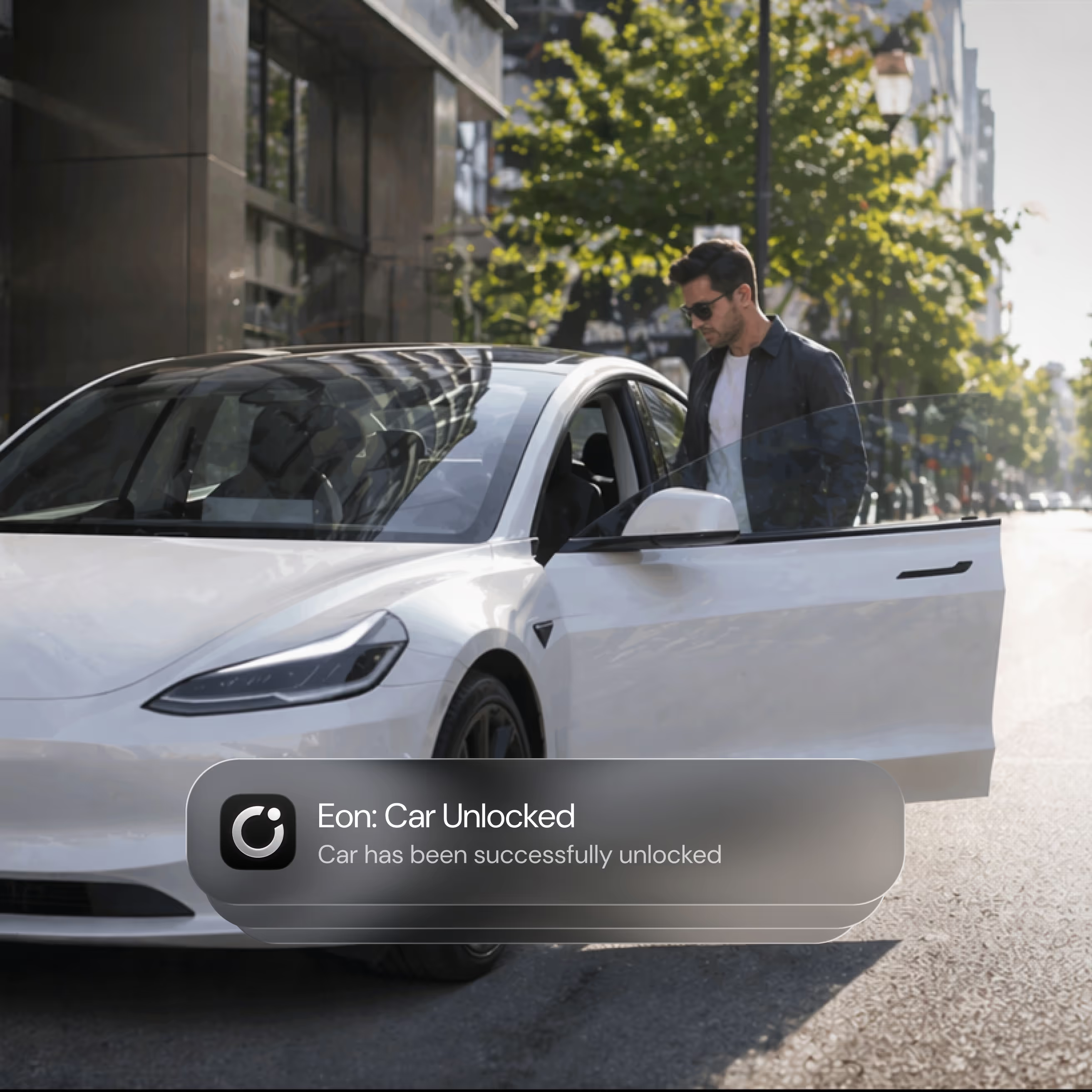
Phone-based vehicle access on Eon's official rental site; source-site terms apply.
A digital key is an access credential
A physical car key answers a simple question: who is holding the object?
That simplicity is useful at home. It becomes limiting when a company has to issue temporary access to a stranger, add another approved driver, end access at checkout, and recover when the device or vehicle does not behave as expected.
A digital key treats vehicle access as a credential. The system can associate it with a user account or device, define when it is valid, and remove it when authority ends. The exact capabilities depend on the car, phone, operating system, automaker, and implementation.
The Car Connectivity Consortium describes a standardized ecosystem for storing, authenticating, and sharing vehicle keys on mobile devices. Its public materials include time-limited access and control over selected functions. That broader standard should not be confused with a claim that every phone-as-key product is CCC certified.
Eon describes its own implementation as phone-based access for supported rentals. Rei Vardi called it a Bluetooth key in E116. Venture Step found no source establishing that Eon's implementation uses the complete CCC architecture, so this explainer treats the industry standard and the Eon case separately.
The handoff moves from a meeting to a lifecycle
The physical exchange looks like one moment. A well-designed digital exchange is a series of decisions.
flowchart LR
    A["Verify the renter"] --> B["Bind access to a device"]
    B --> C["Confirm the vehicle and booking"]
    C --> D["Activate access for the rental window"]
    D --> E["Monitor state and handle exceptions"]
    E --> F["Revoke access and close the trip"]
    D --> G["Approve a separate additional driver"]
    G --> F
A digital rental key is only one control inside a broader identity, vehicle, and recovery lifecycle.
The operator first decides whether the person may rent. It then binds access to the approved account and device, associates that access with the correct vehicle and booking, activates it for the rental, and removes it at the end. If another person needs to drive, that person should receive separate authority rather than an informal copy of the original renter's access.
This lifecycle is more expressive than handing over a fob. It is also easier to get wrong in more places. A bad identity decision, delayed provisioning message, unsupported phone, exhausted battery, stale vehicle state, or failed revocation can block or extend access.
The key is therefore not a replacement for operating design. It makes operating design executable.
Delegation becomes visible
Rei's E116 example begins with an approved renter whose phone becomes the key. If a friend also wants to drive, the friend can be added and reviewed. If approved, that person's phone receives its own access.
The current Eon homepage makes the same product claim: approved drivers can be added in the app and receive separate digital keys.
This changes the risk boundary. A physical key can be passed without the platform knowing whether the recipient has a license, appears in the rental agreement, or satisfies the operator's rules. Device-bound access makes the unauthorized transfer less convenient and gives the legitimate additional driver a proper route.
It does not prevent determined misuse. Rei notes that the original renter could still hand over an entire phone. The control works by raising the cost of going outside the approved path, not by making misconduct physically impossible.
Google's digital-key sharing guidance shows why delegation needs its own design. Compatible systems may let the owner name a shared key, review its settings, send a link, require an activation code or another key, restrict driving functions, and later delete the shared key. Google also warns that deletion may not complete immediately in every vehicle.
The durable design question is not whether a key is shareable. It is whether each recipient, permission, activation, and revocation remains attributable.
Vehicle data moves failure earlier
A traditional handoff can fail when the customer reaches the lot and discovers that the car is absent, discharged, or showing a maintenance warning.
Rei says Eon uses connected-vehicle information to check location, charge, tire pressure, and maintenance alerts before pickup. Eon's current privacy policy says it may collect precise location and in-vehicle telemetry such as speed, acceleration, braking, harsh-event flags, vehicle health, diagnostic data, and trip times.
That data can give the operator a chance to intervene before the customer depends on the vehicle. It can also support an audit of when the trip began, where the car is, or what state the vehicle reported.
The word "reported" matters. Telemetry does not see everything. A sensor can say the battery is charged while the interior is dirty. A location can be correct while the vehicle is blocked in. A diagnostic system can be quiet while a physical defect is visible to a person.
Digital access and telemetry improve the timing and scope of information. They do not turn a connected car into a complete inspector.
Compatibility is part of the product
The phrase "your phone is the key" sounds universal. Current consumer documentation is much more conditional.
Apple's car-key guidance requires a compatible car and eligible Apple device. Setup may begin in the automaker's app, an email or message, or the vehicle display. Features vary by vehicle. Apple says some devices can use power reserve after the phone needs charging, but that capability still depends on the supported setup.
Google's setup guidance limits digital keys to select devices, vehicles, and markets. Pairing can require internet access, a manufacturer app, an activation message, or the vehicle's reader and display.
The rental operator must know which combinations work and tell the customer before the trip. Compatibility cannot be discovered honestly at the locked door.
Offline entry does not mean an offline service
Bluetooth, near-field communication, or ultra-wideband can allow local communication between a phone and vehicle. That can reduce dependence on cellular coverage at the moment of entry.
The wider service still depends on earlier provisioning, a charged and protected device, functioning vehicle hardware, account access, current permissions, and a way to recover when the local credential fails.
Google's safety overview advises users to keep a physical key because the connection may not always be available. That advice comes from a consumer-owner context, not a rental design. The underlying lesson still applies: the operator must provide a fallback that the renter can actually use.
A fallback could be another approved device, a physical key held through a controlled process, remote support, local service, or vehicle replacement. The right answer depends on the implementation. "Call the owner and hope" is not a designed fallback.
Revocation is a safety feature and an operating obligation
Temporary access has to end.
The system should remove the renter's credential when the booking closes, when the device is lost, when a shared driver is no longer approved, or when the operator has a valid reason to terminate access. It should also record whether the revocation reached the relevant account, device, and vehicle.
NIST's current Digital Identity Guidelines treat authentication as a lifecycle that includes binding, protection, recovery, and revocation. NIST is not prescribing car-rental controls. It supplies the more general principle that an authenticator cannot be treated as secure merely because it was issued correctly.
Rental teams also need a safe boundary around remote intervention. Revoking access while a vehicle is moving, stranding a customer without due process, or confusing an account dispute with an immediate safety threat can create new harm. The exact authority and sequence require technical, legal, insurance, and safety review.
What a digital key cannot solve
A digital key can control access. It cannot decide whether the person's identity was proven correctly, whether the insurance arrangement is adequate, whether the car is mechanically safe, whether the customer understands an unfamiliar EV, or whether support will respond when the trip fails.
Eon's current rental terms still address license and insurance verification, deposits, mileage, vehicle responsibility, and condition. Its site promises 24/7 human support. Those are not contradictions to digital access. They are the rest of the product.
The best digital-key experience feels simple because the difficult decisions were made before the customer reached the car. The operator defined who may enter, which device works, what the vehicle should report, when access begins, how it is delegated, when it ends, and who takes responsibility when software is not enough.
Episode 119's [[How to Test a Product Where It Will Actually Fail]] is a useful companion for testing phones, vehicles, networks, batteries, and recovery under real conditions. Episode 117 examines another digital control system inside physical machinery. Episode 25 extends the operating and liability boundary into autonomous vehicles.
Sources
The Eon workflow comes from [[E116 Full Transcript]], Eon's current site, its Apple App Store listing, privacy policy, and rental terms. The industry and device boundaries come from the Car Connectivity Consortium, Apple, Google setup guidance, Google sharing guidance, Google's safety overview, and NIST.
AI assisted with organization, source comparison, and editorial review. Dalton Anderson's transcript and the linked primary sources control the factual claims.
Sources
Follow the evidence.
- Eon's Apple App Store listingapps.apple.com
- Car Connectivity Consortium's Digital Key overviewcarconnectivity.org
- NIST SP 800-63-4nvlpubs.nist.gov
- The Google Play listingplay.google.com
- Apple's car-key support pagesupport.apple.com
- safety overviewsupport.google.com
- key-sharing guidancesupport.google.com
- Google's setup guidancesupport.google.com
- Eon's official siteeonrides.com
- Eon's rental termseonrides.com
- Eon's company storyeonrides.com
- Eon's privacy policyeonrides.com
- Rei's LinkedIn profilelinkedin.com
- NHTSA's recall lookupnhtsa.gov
- Turo's May 17, 2024 amended registration statementsec.gov
- Uber's 2025 Form 10-Ksec.gov
- Lyft's 2025 Form 10-Ksec.gov