Article
Nike Project Amplify: How the Powered Footwear Works
Nike Project Amplify pairs a motor, drive belt, cuff battery, and carbon-plated shoe to assist everyday running and walking, but it remains in testing.
In this article
Nike Project Amplify
Nike Project Amplify is a powered-footwear system in development for running, jogging, and walking. Nike says it is designed to augment natural lower-leg and ankle movement so everyday athletes can move faster or farther with less effort.
The system is not a conventional shoe launch. Nike's first-generation description combines a motor, drive belt, rechargeable cuff battery, and carbon-plated running shoe. The shoe can be worn with or without the robotics system.
Project Amplify remains in testing. Nike has not published a final price, broad release date, complete commercial specification, or independent performance record.
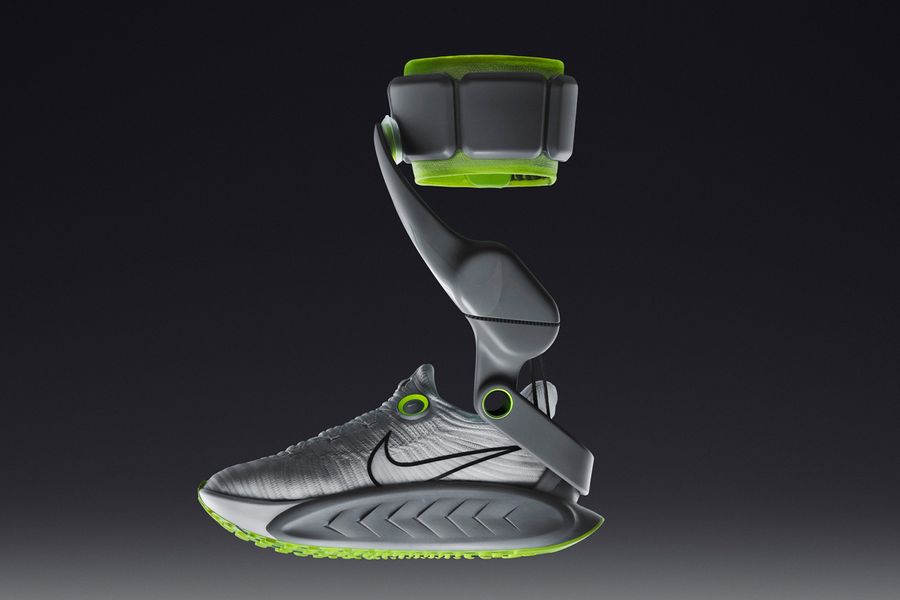
Nike Project Amplify. Official image and product description from Nike.
What Nike announced
Nike unveiled Project Amplify on October 23, 2025 as one of four major technology platforms in a wider innovation package.
The intended user is important. Nike says the first generation is focused on everyday athletes running at roughly a 10-to-12-minute-mile pace. It is not designed for fast competitive runners trying to remove seconds from a race time.
Nike compares the idea to the role of an electric bicycle. The system is intended to add assistance while the person remains the source of movement and control.
The company's announcement says the work remains early in testing. Nike is collaborating with robotics company Dephy and intends to work toward a broader consumer launch in coming years.
How the system is described
| Component | Nike's current description |
|---|---|
| Shoe | Carbon-fiber-plated running shoe that can be used with or without the robotics system |
| Actuation | Lightweight motor and drive belt |
| Power | Rechargeable battery worn in the cuff |
| Control input | Motion algorithms informed by the Nike Sport Research Lab |
| Target movement | Running, jogging, and walking |
| Intended effect | Assistance to lower-leg and ankle movement |
| Product stage | Early testing toward performance readiness |
Nike has not published enough detail to evaluate the final weight, battery life, charging time, waterproofing, fit range, maintenance, repair, software support, replacement components, warranty, or commercial compatibility.
What the system does not establish yet
Nike's announcement supports the architecture and intended experience. It does not independently prove the benefit.
The public material does not establish how performance changes across bodies, paces, terrain, weather, fatigue, footwear preferences, or long-term use. It does not establish safety outcomes, durability, service life, accessibility, support burden, or whether the final product will be suitable for a particular person.
The product also should not be described as a medical device or treatment. Nike frames it as powered footwear for everyday movement.
Nike and Dephy
Dephy identifies itself as Nike's official robotics partner for Project Amplify. The company develops powered ankle-wearable technology and maintains a separate product called the Sidekick.
The partnership makes Dephy relevant to Project Amplify's robotics layer. It does not make the Dephy Sidekick and Nike Project Amplify the same product. Their customer, shoe, service, pricing, warranty, and commercial status must be checked separately.
Dephy's own material can help a reader understand the broader category of powered ankle assistance. It cannot fill missing Nike specifications unless Nike explicitly adopts them for Project Amplify.
Why the product matters
Project Amplify moves footwear from passive materials into a system involving actuation, power, sensing or motion input, software, fit, and service.
That changes the product questions.
A conventional running shoe can fail through fit, wear, traction, construction, or mismatch with the runner. Powered footwear retains those concerns and adds charging, component life, firmware or control behavior, attachment, repair, replacement, support, and safe failure.
The business model may also change. A durable powered component and a replaceable shoe could create a different purchase and service cycle from ordinary footwear. Nike has not yet published the commercial model, so that remains a design question rather than a fact.
What would count as useful evidence
The next phase should make performance readiness more concrete.
Useful evidence would identify the test population, comparison condition, pace and terrain, duration, assistance setting, fit method, failure rate, subjective experience, energy or performance measure, and the difference between a prototype result and the final commercial system.
Commercial readiness would add price, availability, supported regions, warranty, returns, battery and charging specifications, replacement parts, repair, support, compatibility, privacy, and software-maintenance terms.
Independent testing would strengthen the record because the current description is supplied by Nike and its robotics partner.
Availability and how to follow it
Project Amplify is not presented by Nike as a broadly available retail product. The official Project Amplify page is the primary route for the announcement and media assets. Nike's innovation-engine page places it within the company's wider technical portfolio.
Dephy's company page confirms its role as Nike's robotics partner. Dephy also maintains public information about its separate Sidekick system, which should not be used as a substitute purchasing route for Project Amplify.
There is no verified Project Amplify app or setup flow to document as of July 27, 2026.
Why Project Amplify appears on Venture Step
E114 examines whether modern Nike can recover the product-learning edge visible in Phil Knight's Shoe Dog. Project Amplify matters because it is an ambitious current project tied to athlete research, footwear, robotics, and a real testing boundary.
It is evidence that Nike is presenting a new innovation direction. It is not evidence by itself that the direction has produced a safe, durable, desirable, or profitable consumer product.
That distinction keeps the product interesting.
Verification and disclosure
This profile was checked on July 27, 2026 against Nike's official announcement, Nike's broader innovation release, and Dephy's official company description.
The profile should be refreshed when Nike publishes pricing, availability, specifications, testing results, user documentation, warranty, support, software, privacy terms, or a material change in product scope. AI assisted with research organization and drafting; evidence boundaries and final editorial decisions remain Dalton Anderson's.
Sources
Follow the evidence.
- Bill Bowerman's product workabout.nike.com
- the Swooshabout.nike.com
- innovation-engine announcementabout.nike.com
- Phil Knight and Bill Bowerman's January 25, 1964 partnershipabout.nike.com
- Project Amplify announcementabout.nike.com
- fiscal 2025 full-year releaseinvestors.nike.com
- first-quarterinvestors.nike.com
- second-quarterinvestors.nike.com
- fiscal 2026 full-year releaseinvestors.nike.com
- third-quarterinvestors.nike.com
- 1991 paper on exploration and exploitationpubsonline.informs.org
- Zhang, Hempel, Han, and Tjosvold, 2007scholars.ln.edu.hk
- 2007 dynamic-capabilities papersms.onlinelibrary.wiley.com
- 2025 open-access study of 87,911 European firmsnature.com
- Wang, Huang, Davison, and Yang, 2018sciencedirect.com
- Choi, Lee, and Yoo, 2012sciencedirect.com
- fiscal 2026 Form 10-Ksec.gov
- official Simon & Schuster page for *Shoe Dog*simonandschuster.com