Episode Story
What Nike Lost and What Shoe Dog Preserves
E114 places Phil Knight's improvised Nike beside its current channel reset to ask what a company must preserve when scale changes how it operates.
In this article
What Nike Lost and What Shoe Dog Preserves
Nike does not need to become Blue Ribbon Sports again. It needs to recover the operating capabilities that made Blue Ribbon Sports dangerous.
That is the tension at the center of Venture Step episode 114. Phil Knight's Shoe Dog remembers an improvised, cash-starved company built around runners, shoes, supplier relationships, and a refusal to stop. Modern Nike is the world's largest seller of athletic footwear and apparel, with $46.4 billion in fiscal 2026 revenue, a global retail network, digital platforms, wholesale accounts, and nearly all production handled by independent contractors.
Scale did not make Nike less real. It changed the distance between a problem and the person allowed to solve it.
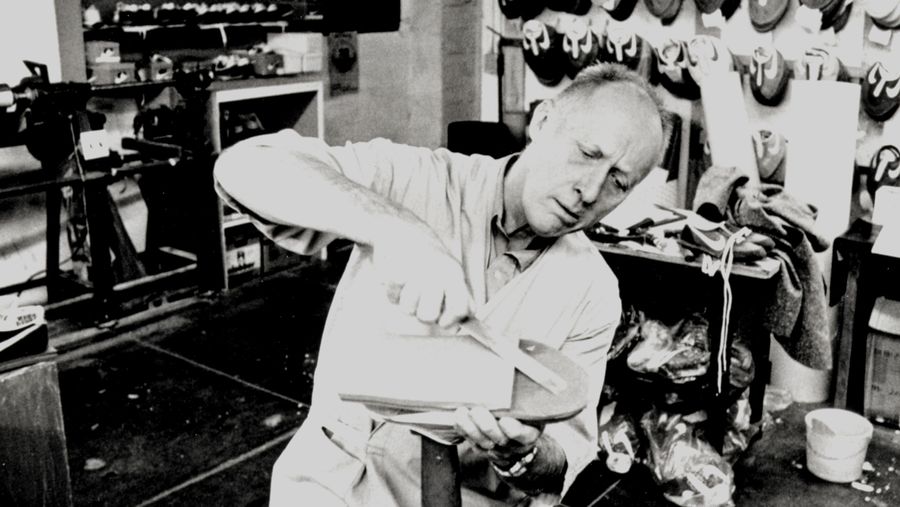
Bill Bowerman in Nike's Eugene lab. Image and history from the Nike archive.
The memorable object was a feedback loop
The waffle iron is the part everyone remembers. Bill Bowerman poured urethane into a household appliance while trying to make a flexible sole with better traction. The first attempt stuck. The idea survived, moved into hand-built prototypes, reached athletes at the 1972 Olympic trials, and eventually became the Waffle Trainer.
The object is charming. The loop around it is more useful.
Bowerman coached runners. He watched bodies move. He cut apart shoes, changed materials, challenged accepted ideas about cushioning and traction, and returned the result to athletes. Nike's archive credits him with eight registered patents and describes the Cortez, continuous midsole, waffle sole, raised heel, nylon upper, and other changes that emerged from that proximity.
E114 calls this being customer zero. The phrase does not mean every founder must personally represent an entire market. It means the company had unusually short access to real use. A dissatisfied athlete was not an abstract persona several reports away from the product decision.
flowchart LR
    A["Athlete encounters a problem"] --> B["Specialist observes it"]
    B --> C["Product changes"]
    C --> D["Athlete tests the change"]
    D --> E["Failure and performance evidence"]
    E --> C
    E --> F["A product earns distribution"]
Early Nike's edge was not experimentation alone. It was the speed and fidelity of the loop.
The company was also a network of obligations
Shoe Dog is full of shoes, but much of its suspense comes from cash. Blue Ribbon Sports needed inventory before it could sell. Larger orders consumed more money. Banks disliked the risk. Japanese suppliers could determine whether the company had product at all. Retail commitments helped turn future demand into something a lender could understand.
This is why the memoir resists the clean founder myth. Growth can intensify a financing problem. A product company can be commercially right and still run out of cash between an order, shipment, and customer payment.
It also explains why distribution belongs in the identity story. Retailers were not merely a cost between Nike and a buyer. They were demand, discovery, physical presence, market feedback, and an operating relationship.
The company in the book survives because a network keeps choosing to carry it. The people are eccentric. The management style is often sparse. Some choices should not become management advice. Yet the group repeatedly combines technical judgment, selling, credit, law, logistics, and belief into another chance to operate.
That is more interesting than grit by itself.
Direct became an answer larger than the question
Nike's modern direct-to-consumer strategy had sound logic. Owned digital and retail channels can control presentation, deepen membership, collect first-party data, offer broader assortment, and retain more of the economics from an individual sale.
The problem appears when the direct channel is treated as the whole customer relationship.
A customer inside Nike's app has already entered Nike's environment. A customer in a multi-brand store may still be comparing Nike with Hoka, On, Altra, Adidas, or another specialist. The retailer sees the choice before the brand wins it. It also supplies a place to touch, try, compare, and receive local advice.
Dalton's episode argument is that Nike overcorrected and created space for focused competitors. The public evidence cannot reduce Nike's performance to one cause. Product assortment, geography, leadership, competition, discounting, consumer demand, tariffs, and other forces all matter. Nike's own fiscal 2026 filing warns about reduced barriers to starting footwear brands, nimbler competitors, changing preferences, retail shifts, and the continuing investment and fixed costs required by Nike Direct.
The numbers nevertheless show a meaningful reset. In fiscal 2026, Nike Brand wholesale revenue rose 6 percent on a reported basis while Nike Direct fell 6 percent. In the fourth quarter, wholesale rose 4 percent while Direct fell 7 percent. The company now describes reinvesting in wholesale distribution and elevating physical retail as part of marketplace management.
That is not an admission that direct was useless. It is recognition that a channel portfolio performs several jobs at once.
Announcing invention is not recovering an edge
Nike is again presenting ambitious technical work. Its October 2025 innovation package included Project Amplify, Nike Mind, Aero-FIT, and Therma-FIT Air Milano. Project Amplify combines a carbon-plated shoe with a motor, drive belt, and rechargeable cuff battery intended to assist lower-leg and ankle movement.
The announcement is visually and conceptually bold. Nike also says the system is still early in testing and is being developed with robotics partner Dephy for a broader launch in coming years.
That boundary matters. An announcement proves that a project exists and that Nike wants to frame it as athlete-centered innovation. It does not yet prove safety, durability, comfort, demand, independent performance, unit economics, or broad availability.
The same distinction applies to a turnaround. A company can recover an innovation vocabulary before it recovers an innovation system.
Identity is a set of repeated decisions
When people say a company has lost its identity, the language can become mystical. Leaders reach for founder stories, old logos, headquarters rituals, or a campaign about returning to the roots.
E114 offers a harder test.
Who is close enough to see the user's problem? Which specialist understands the small tradeoff? Who can authorize a change? How quickly does field evidence reach that person? Which partner sees choices the company cannot observe inside its own channel? Does the organization protect experiments long enough to learn from them? Can it stop work that no longer expresses the edge?
An identity becomes real through those decisions.
James March's classic work on organizational learning helps explain why recovery is difficult. Organizations refine exploitation of what they already know faster than they explore uncertain possibilities. That tendency can make the system efficient in the short run while weakening its long-run adaptability. Returning to experimentation does not require abandoning the existing business. It requires giving exploration a place, resources, evidence standards, and decision rights that routine optimization cannot quietly absorb.
Nike cannot responsibly operate like a few people selling shoes from a car. It now carries public-company obligations, global employment, contracted manufacturing, data systems, stores, suppliers, and material brand risk. Nostalgia would ignore those responsibilities.
First principles survive scale differently. Athlete proximity can become repeated field research rather than one coach's intuition. Technical experimentation can have safety and validation gates. Specialist memory can remain visible inside cross-functional work. Wholesale partners can be treated as market sensors instead of pipes. A project can earn continued investment through evidence rather than the prestige of its launch.
What Shoe Dog actually preserves
The memoir does not provide an objective history of Nike. It is Knight's account, built from his perspective and ending before much of the modern corporate story. It cannot settle later questions about labor, governance, strategy, or every person who helped build the company.
What it preserves unusually well is the feeling of dependence. The company depends on the next order, bank decision, shipment, legal outcome, athlete, and teammate. The future Nike is not yet inevitable.
That fragility makes the early operating system visible. Product judgment, user proximity, financing, distribution, and human commitment have to meet at the same moment. None is the company alone.
Modern Nike's channel reset and new product work are signs of movement. Fiscal 2026 revenue was roughly flat on a reported basis, net income was down 3 percent, wholesale improved, Direct declined, and management said sell-through remained challenged. Those facts describe a company in transition, not a finished recovery.
The episode's useful question is therefore not whether Nike can become its old self.
It is whether a very different Nike can again make the user, specialist, experiment, partner, and evidence feel like one operating system.
Listen to Venture Step E114 for Dalton Anderson's full review of Shoe Dog and his argument about Nike's product identity, channel choices, and current attempt to lead with sport.
Continue the series
The Shoe Dog review examines the memoir as an operating story rather than a complete history. The DTC analysis goes deeper on distribution economics and market sensing. Episode 115 extends the distinction between a visible outcome and the capability that can reproduce it. Episode 119 examines why real use reveals more than controlled confidence.
Sources and disclosure
The historical record uses the official Shoe Dog publisher page and Nike's company-authored archive on the 1964 Blue Ribbon Sports partnership, Bill Bowerman's product work, and the early Swoosh. Current company and channel claims use Nike's fiscal 2026 Form 10-K, fiscal 2026 full-year release, and Project Amplify announcement. The exploration and exploitation boundary comes from James March's 1991 paper.
Dalton Anderson's preserved E114 transcript controls his interpretation and personal observations. Company archives, filings, and announcements control their own facts and claims. AI assisted with research organization and drafting; the episode viewpoint, source boundaries, and final editorial decisions remain Dalton's.
Sources
Follow the evidence.
- Bill Bowerman's product workabout.nike.com
- the Swooshabout.nike.com
- innovation-engine announcementabout.nike.com
- Phil Knight and Bill Bowerman's January 25, 1964 partnershipabout.nike.com
- Project Amplify announcementabout.nike.com
- fiscal 2025 full-year releaseinvestors.nike.com
- first-quarterinvestors.nike.com
- second-quarterinvestors.nike.com
- fiscal 2026 full-year releaseinvestors.nike.com
- third-quarterinvestors.nike.com
- 1991 paper on exploration and exploitationpubsonline.informs.org
- Zhang, Hempel, Han, and Tjosvold, 2007scholars.ln.edu.hk
- 2007 dynamic-capabilities papersms.onlinelibrary.wiley.com
- 2025 open-access study of 87,911 European firmsnature.com
- Wang, Huang, Davison, and Yang, 2018sciencedirect.com
- Choi, Lee, and Yoo, 2012sciencedirect.com
- fiscal 2026 Form 10-Ksec.gov
- official Simon & Schuster page for *Shoe Dog*simonandschuster.com